
Give your team an unfair advantage
SEVA helps your team focus on things that matter, automates the rest so they can get creative—not sedative.
27 September 2026
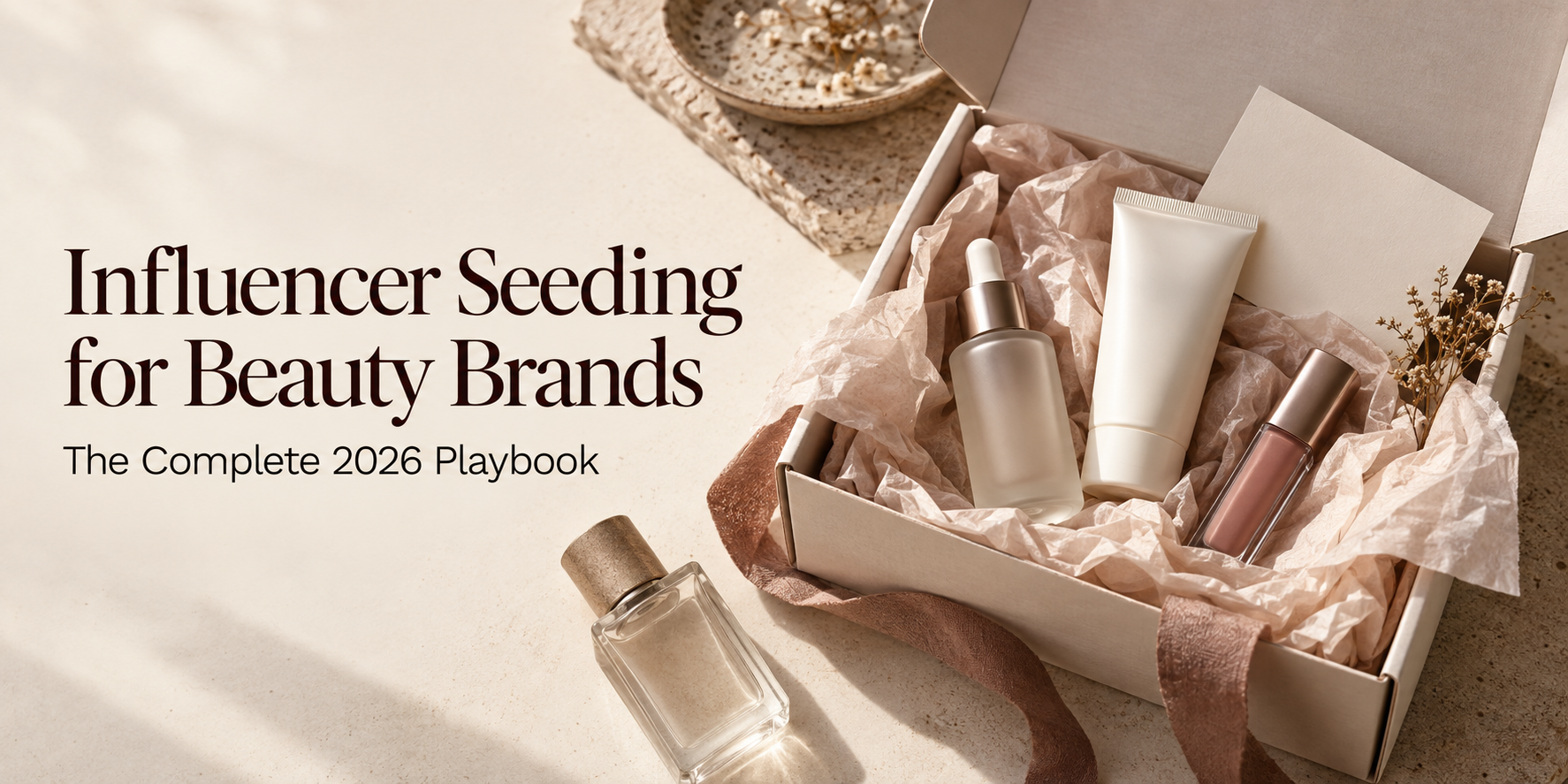
Influencer seeding is the practice of sending free product to a targeted group of creators with no contractual obligation to post, so the ones who genuinely like it talk about it in their own words. For beauty brands, it is the lowest-cost way to generate real content, build a pipeline of affiliate and paid partners, and test creator fit before spending a dollar on fees.
Last updated: September 2026
Low unit cost relative to the content it produces. A seeded unit costs landed cost of goods plus a shipping label, not a rate card. Average selling prices on TikTok Shop US beauty in Q2 2026 ran from roughly $15 for makeup to roughly $27 for fragrance, per Playbook of Beauty. Making and shipping one unit costs a fraction of that, which makes an honest 30-second review among the cheapest usable content a beauty brand can get.
The product demonstrates itself on camera. Texture, swatches, wear tests, a wash-day curl pattern: creators already know these formats, and the platforms reward them. TikTok Shop's beauty and personal care category did $2.08 billion in US sales from January through June 2026, its largest category, per WWD.
Fit is granular, and a miss is visible. A foundation two shades off, or a curl cream sent to fine, straight hair, produces a bad on-camera moment or a polite silence, and you paid for the unit either way. The cheapest category to seed is also the most expensive to seed carelessly, which is why this playbook is built around matching creators to products at scale.
The distinctions matter for planning.
Product-only compensation is mainstream: in Influencer Marketing Hub's 2024 benchmark survey, roughly 30% of brands compensated influencers with free product samples, against roughly 40% paying money (Influencer Marketing Hub). The decision rules: seed when you are launching, entering a new platform, need content volume, or want to test creator fit before paying anyone. Pay when you need a deliverable on a fixed date, reviewed claims (SPF, clinical results) or ad rights. Move seeded creators to affiliate once they have posted; a commission aligns incentives without a negotiation.
For most DTC beauty brands the sequence is seed, then affiliate, then paid for the few who have proven both fit and pull. See how Rare Beauty built a community-first creator program, and the companion skincare influencer gifting program guide for the first stage.
Pick a single primary goal per cycle: content volume, awareness on one platform, an affiliate pipeline, or launch buzz. Then define the metrics in writing:
Last-click revenue in week two is the classic way to kill a seeding program that was working; the CMO guide to influencer marketing budgeting covers how to split spend between seeding, paid and affiliate.
Build the list from content, not bios. Search for the problem your product solves ("dry patches under foundation," "low-porosity curls," "office-safe gourmand") and shortlist creators who already make that content, in an aesthetic your product looks native in, for an audience that asks buying questions in the comments. Then vet:
Mine communities that have done the vetting for you: members of retailer programs like Sephora Squad, customers who tag you, your affiliates' peers. Our breakdown of how Sephora Squad selects creators is a good model for your criteria, and source three creators for every unit you plan to ship, because vetting and acceptance thin the list.
Use a template with variable slots for the parts that must be personal, let AI draft those slots from the creator's recent content, and have a human review the first batch. Every message should contain:
A default cadence: first touch day 0, a short bump in the same thread day 3, a final touch day 8 with a real deadline ("this batch ships Friday"). After delivery: a "did it arrive" note with one usage tip around day 2, a question rather than an ask around day 7 to 10, and a day-30 message that invites posters to affiliate or asks non-posters for feedback. For the psychology of those later touches, see the art of follow-on communications.
The most consequential operational choice in beauty seeding is whether the creator picks the product or you do. The scalable version is a branded, per-creator page where they enter a shipping address, select their shade or product from your live catalog, accept the terms (disclosure expectations, any reshare permission), and the order flows into Shopify as a zero-dollar order, like any other sale.
Letting creators choose tends to lift post rates for reasons that are about people, not software: the product fits, so it works in their footage; choosing is a small act of ownership, so they are already planning how to use it; they pick what suits what they are filming next month; and you stop shipping dead units.
Operationally, addresses are collected once and correctly, inventory stays accurate, and nobody keeps a spreadsheet of creators' home addresses. The box still counts: read how to build an influencer package worth filming, and give the insert card three jobs: how to disclose, a QR code to the affiliate signup, the one-line product story. See also how Pela Case scaled gifting and seeding.
Contact 300 creators and you will get replies about shade availability, fragrance allergies, a changed address, and "I posted, did you see it?" Each is both a relationship moment and a fulfillment step, and a shared inbox breaks somewhere around 50 active conversations.
An influencer CRM gives every creator a status (contacted, replied, claimed, shipped, delivered, posted, affiliate), a conversation history the whole team can see, a profile with skin or hair type and shade, and a next-action date, and lets you message hundreds of creators at once with personalization, segmented by status. Sacheu, the beauty brand founded by creator Sarah Cheung, hit this wall with spreadsheets before moving its program into a CRM; the story is in why influencer CRMs are essential for brand growth.
Posts. Monitor tags, mentions, hashtags and each creator's handle, log every post against the creator record, and capture the content within 48 hours. Stories vanish, and so does your proof.
Usage rights. Gifted is not licensed. A reasonable default: you may reshare to your own organic channels with credit if the creator agreed when claiming the product. Anything paid (ads, whitelisting, product pages) needs written permission per asset and usually a fee.
Disclosure. Free product is a material connection. The FTC's Endorsement Guides FAQ says brands that send free products should tell influencers to clearly and conspicuously disclose the gift in any resulting posts (FTC, Endorsement Guides: What People Are Asking), and its Disclosures 101 for social media influencers shows what that looks like. Build it into your claim terms and insert card. Our summary is in FTC guidelines for affiliates, creators and brands.
Affiliate sales. Creators who posted get an affiliate invitation: a personal code or link, a commission rate, optionally an audience discount, and a minimum-cart rule so the discount does not erase margin on a travel-size. Attribution then connects each creator's content to the orders it produced, which decides who gets re-seeded and who gets a paid offer. Pay out on a published schedule.
Each order of magnitude breaks something different. At 20 creators a spreadsheet works. At 50, addresses go wrong and follow-ups get missed. At 100, reply volume, tracking gaps and inventory surprises arrive together. To scale without hiring: ship in weekly batches of 20 to 25 rather than one monthly dump; tier creators so A-tier posters get affiliate and paid consideration while B-tier get re-seeded on every launch; re-seed posters on every launch and restock; and trigger follow-ups from events (claimed, shipped, delivered, posted), not from someone remembering.
The target operating model is one marketer running the program while the platform does the sending, tracking and nudging. For tool selection, see the best influencer marketing platforms for beauty brands comparison, the GRIN alternatives for beauty brands roundup, and how to build million-dollar influencer campaigns without agencies.
Everything here is an illustrative assumption, not an industry benchmark. Say you seed 100 skincare creators with one full-size serum. Landed cost of goods $14, shipping $8, packaging and insert $3: $25 per unit, $2,500 in product for the cycle.
The levers, in order of impact: targeting, product choice, follow-up, packaging. Vendor guides do publish post-rate figures (Skeepers cites 20% to 40% for gifted collaborations in its product seeding guide), but they are self-reported and unaudited, and vendors' ranges disagree. Your own first cycle is the only benchmark that matters.
SEVA is an AI-powered influencer marketing platform built for DTC and consumer brands to scale product gifting and seeding without stitching together several tools or adding headcount. That maps onto the seven steps above:
Sacheu, the beauty brand founded by creator Sarah Cheung, used SEVA to scale its creator partnerships on TikTok Shop and Instagram after spreadsheets stopped scaling; the full account is in the Sacheu story. To see it running on your own catalog, book a demo.
Influencer seeding is sending free product to a selected group of creators with no obligation to post, run as a repeatable system: criteria-based sourcing, templated outreach, creator-chosen fulfillment, follow-up and tracking. Gifting is the same gesture done one-to-one with creators you already know. In practice, a brand gifts ten people and seeds a hundred.
Start with a batch you can follow up with properly, typically 20 to 25 creators a week, so 80 to 100 in a first monthly cycle. Source about three candidates per unit you plan to ship. Scale to 200 or more a quarter once your acceptance and post rates are documented.
Treat published figures with suspicion; vendor ranges are self-reported and inconsistent, so your own first cycle is the only real benchmark. Measure post rate as creators who posted within 45 days of delivery divided by creators who received product, then work the levers: tighter targeting, creator-chosen product, and a follow-up around day 7 to 10.
Yes. The FTC treats free product as a material connection, and its Endorsement Guides FAQ says a brand that sends free product should ask creators to clearly and conspicuously disclose it in any resulting posts. Put the expectation in your outreach and claim-page terms, and ask creators to tag the brand so you can log the post.
For sales-linked seeding, TikTok is hard to argue with: beauty and personal care was TikTok Shop's largest US category in the first half of 2026 at $2.08 billion, per WWD, with skincare at 36% of Q2 beauty GMV per Playbook of Beauty. Instagram still wins for polished, reusable content. Seed both, let creators pick, and study Bubble Skincare's Gen Z build.
Seed first. A new brand does not yet know which creators fit. Seeding 100 creators identifies the ones who post unprompted; push them to affiliate and, for a handful, to paid deals with guaranteed deliverables and usage rights. Go paid immediately only when a hard date, reviewed claims or ad rights are non-negotiable.
An influencer seeding platform combines creator discovery, outreach automation, a CRM, creator product-selection pages tied to your Shopify store, post tracking and affiliate attribution in one system. You need one when volume breaks manual work, which for most beauty brands happens between 50 and 100 creators a cycle. Below that, a disciplined spreadsheet and a shared inbox can hold.
Ready to run seeding as a system instead of a scramble? Book a demo and we will walk through discovery, outreach sequences and Shopify-connected product-selection pages on your catalog.
SEVA helps your team focus on things that matter, automates the rest so they can get creative—not sedative.

SEVA AI helps you scale influencer marketing, effortlessly.
Email: sales@heyseva.com