
Give your team an unfair advantage
SEVA helps your team focus on things that matter, automates the rest so they can get creative—not sedative.
27 September 2026
Influencer marketing for fragrance brands works best as a seeding program, not a sponsorship budget. Ship inexpensive discovery sets to a large, vetted pool of fragrance-literate and lifestyle creators, let them review honestly on camera, then convert the ones whose content lands into affiliates on TikTok Shop and your own store. Scale comes from software that handles discovery, outreach, fulfillment and attribution, not from adding headcount.
Last updated: September 2026
The sample is cheap and the story is not. A 2 ml vial holds enough for several wear tests and ships in a padded envelope, so a brand can put a discovery set in front of several hundred creators for the price of a handful of paid posts. Skincare needs weeks to show results and haircare needs full sizes. Fragrance needs one spray.
Scent cannot travel through a screen, so description is the product. Glossy's reporting on fragrance on TikTok Shop describes a category running on blind buys driven by storytelling, reviews and creator recommendations, and puts fragrance at roughly $218 million in TikTok Shop sales from January through June 2026, the largest beauty segment on a marketplace where Beauty Independent reports beauty sales neared $1 billion in each of the first two quarters of 2026. The creator is the only sensory proxy the customer gets.
Customers build wardrobes, not signature scents. Trend data from Spate and others points to a rotating "fragrance wardrobe," with layering of body oils, mists and hair perfumes as its own content genre. One converted creator can move several SKUs, and a discovery set shows the range.
The category has two gifting peaks. Circana's holiday outlook expected US prestige fragrance to exceed $4 billion in the fourth quarter of 2025, with gift sets more than a quarter of Q4 sales and December roughly 60 percent of the quarter; Valentine's Day is a smaller second peak. Circana's 2025 read had prestige fragrance up 5 percent in dollars with mass growing about three times as fast, and Retail Dive named fragrance a growth driver again in the first half of 2026.
The candid caveat: cheap samples are cheap for everyone. WWD reported that dupe house Oakcha grew first-half TikTok Shop revenue from about $5,000 in 2024 to $6.2 million in 2025, and Glossy has tracked Dossier and MCo Beauty into Target and Alt Fragrances into Sally Beauty. The creators you want already receive boxes every week; your program has to be better organized than theirs.
The PerfumeTok reviewers: collection tours, blind-buy reactions, wear tests, dupe comparisons. Cosmetics Business credits this community with turning niche houses into status symbols and pulling lesser-known brands into the mainstream. Their audiences trust them because they are sometimes brutal.
Fragrance is the last step in a get-ready-with-me video. Tribe Dynamics observed that minimalist houses like Diptyque, Byredo and Le Labo appear as often in influencers' living rooms and bathrooms as in review videos; this is where bottle design earns its keep.
Men's grooming, date-night content, "smellmaxxing," office style, wedding prep. Premium Beauty News notes that creators approach perfume through design, brand history or the moment they wear it, and that candid formats like vlogs build unusually strong connection. Vet on audience demographics and on comments that show purchase intent ("link?") rather than compliments. For the long-term version of this, see how Rare Beauty built its creator community.
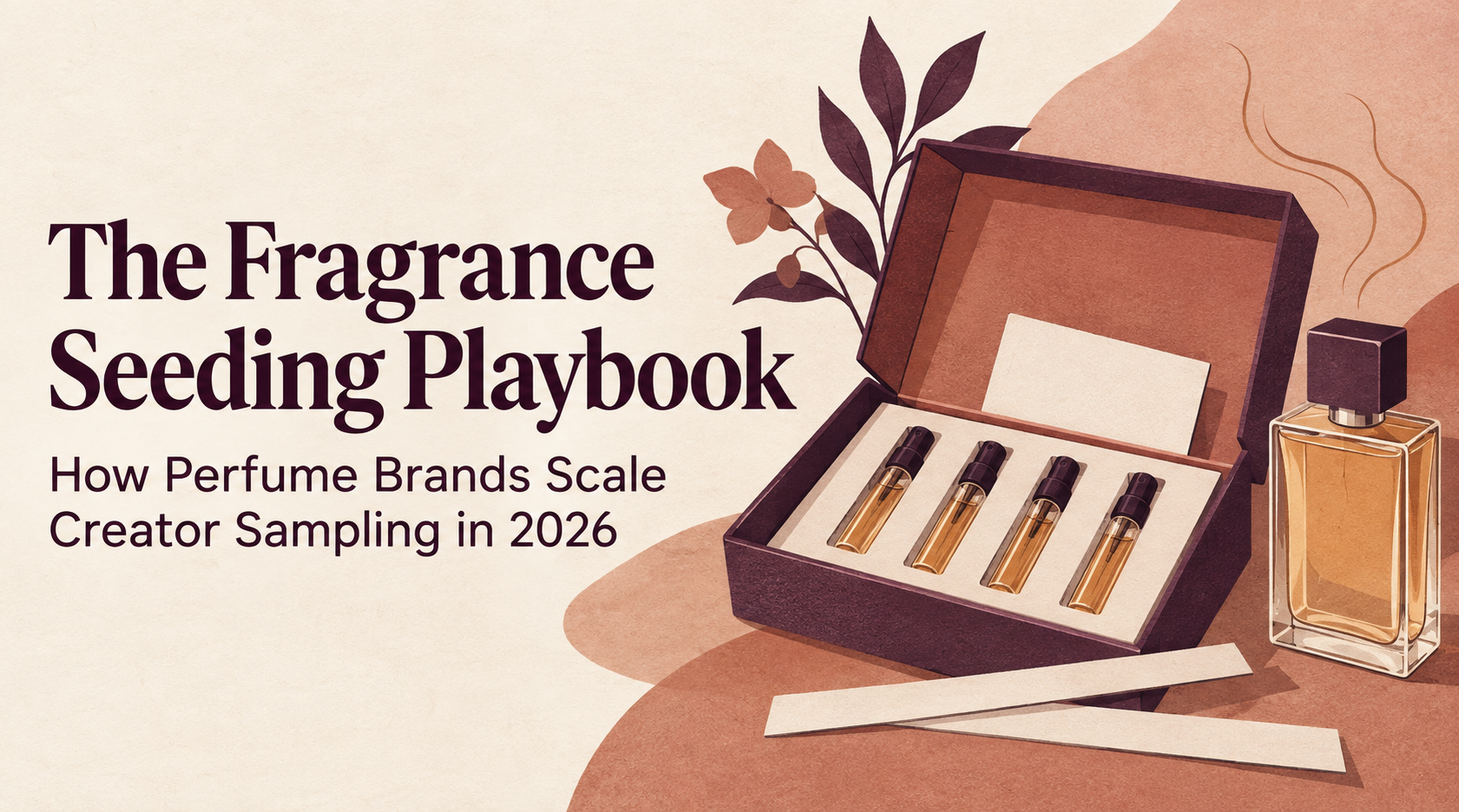
Default to the discovery set, and let the creator pick. Glossy has reported on DTC house Henry Rose using a five-scent, 2 ml discovery set with a $20 credit toward a $120 purchase, with conversion to full size described as high double digits, and Beauty Independent notes that Bellavita gained popularity on TikTok Shop via discovery sets. For creators, the set produces comparison content and lets someone who hates gourmands find your citrus instead of quietly not posting about your vanilla.
Reserve full bottles for fragrance-first creators with proven output. For them the bottle is the content: shelf placement, collection videos, the "empty bottle" review. Send it after a discovery set has produced a post.
Respect the blind-buy review culture. Creators tell audiences whether to buy sight unseen; require positivity and you get flat content the audience discounts. Brief the notes, the story behind the composition, two or three occasions, a layering idea, and explicit permission to compare with anything, including dupes. Ask for a multi-day wear test. Then stop.
Do not script adjectives, longevity claims in hours, compliment stories, or any line positioning your scent as a dupe. Creators can smell a talking point; see creative freedom versus the brand brief. Because vials are visually boring, label each one and add a card with the note pyramid and a short link to the creator's affiliate page; our guide to building an influencer package worth unboxing on camera goes deeper.
Personalize on scent, not flattery. Fragrance creators receive so many offers that "we'd love to send you our new scent" is deleted on sight. Reference a fragrance they reviewed and connect it to one of yours: "You wanted a less sweet Khamrah-style amber; our third scent is exactly that." AI drafting is useful here because that detail differs for every creator while the rest of the email can be templated.
Run a sequence, not a message. An invitation, a follow-up three to five days later that adds one new fact, a final nudge, a check-in when the box arrives, and a thank-you after the post that opens the affiliate conversation. Our piece on follow-on communications covers the tone.
Keep the history. You will contact the same creators several times a year, and a CRM holding every prior message, shipment and post makes your Valentine's outreach to a holiday creator read as a relationship rather than a fresh pitch.
The operational failure in most seeding programs is the spreadsheet: addresses copied from DMs, scent preferences guessed, zero-dollar orders keyed into Shopify by hand. At fifty creators this is annoying; at five hundred it is a part-time job and a source of wrong-scent shipments that never become posts.
The fix is a branded, per-creator signup page where the creator selects their scents (or scent family, if you want to control which SKUs are sampled), enters an address and agrees to your terms, including disclosure. The selection runs through a checkout connected to your Shopify store, so the gifted order is placed in your Shopify store like any other order and you know who received what and when.
One fragrance-specific note: alcohol-based perfume is a restricted item for many carriers, with ground-only or quantity limits, and international shipping is materially harder, so check current rules before promising a creator abroad a box. For a DTC brand that ran gifting as its primary growth channel, read the Pela Case gifting and seeding breakdown; skincare gifting programs and haircare seeding have their own guides.
Seeding produces awareness. Affiliate structure produces the revenue that justifies it, through three channels.
TikTok Shop. Glossy names Lattafa, Bellavita, Dossier and Armaf among the biggest fragrance brands on the marketplace. Creators already selling fragrance through Shop affiliate links are your highest-intent partners, because they have proven they can move a blind buy. Have your listing live before the sets ship.
Your own store. Personal codes and links, commission on attributed sales, and a minimum-cart rule that applies the creator's discount only above a full-bottle threshold, which protects sample margin while rewarding the conversion you actually want.
Commission tiers as a fit signal. A higher tier for creators who post multi-day wear tests or consistently drive attributed orders, a base tier for everyone else. Tiers are a screening tool; the percentages depend on your margin.
Disclosure is not optional. FTC endorsement rules cover gifted product as well as paid posts, and "#gifted" buried in a wall of hashtags does not meet the standard. Our FTC guide for affiliates, creators and brands shows compliant disclosures for a caption, a Reel and a livestream.
Track these by creator, platform and campaign, in this order:
Most seeded content will not convert. A minority of creators produce most of the revenue, and you only find them by seeding widely first, which is why fulfillment and attribution plumbing matters more than any single creator choice.
Every number below is an assumption chosen to show how the math fits together; replace each with your own data.
Assume an independent US fragrance house with six scents seeds 400 creators in a quarter: 120 fragrance-first, 200 lifestyle, 80 adjacent-niche. Assume a 30 percent post rate (120 pieces of content), 15 percent of posters accepting an affiliate invitation (18 affiliates), and a landed cost of $14 per seeded creator. Seeding costs $5,600, about $47 per piece of content before commission.
Now assume the 18 affiliates average 12 attributed full-bottle orders each over two quarters at a $110 average order: 216 orders and roughly $23,800 in attributed revenue against seeding spend plus commission. Whether that is good depends on your margin. The point is that each input maps to a fix: scent selection for post rate, follow-up for affiliate acceptance, commission structure for orders per affiliate.
SEVA, founded by CEO Shivam Sharma, is an AI-powered influencer marketing platform built for DTC and consumer brands to scale product gifting and seeding without stitching together multiple tools or adding headcount. Mapped to this playbook:
Beauty brand Sacheu scaled creator partnerships on TikTok Shop and Instagram using SEVA; the details are in why influencer CRMs are essential for brand growth. See also our roundup of influencer marketing platforms for beauty brands and the category-agnostic influencer seeding playbook for beauty brands.
Most of what ranks for "influencer marketing for fragrance brands" today is agency pitch pages. Agencies are fine if you want someone else to run the program; if you want to own the relationships and the data, this is how brands build large influencer programs without an agency.
Enough that a realistic post rate still produces a visible wave. If roughly a third of seeded creators post, 300 discovery sets yield about 100 pieces of launch-week content, a wave rather than a trickle. Seed four to six weeks ahead so content is edited and scheduled by launch day.
Discovery sets first, almost always. They cost a fraction of a bottle, let the creator choose a scent they will actually like and generate comparison content, the format fragrance audiences watch. Send a full bottle as a second touch to fragrance-first creators who have already posted; for them the bottle itself is content.
Look for creators who discuss drydown, longevity and projection rather than only the opening, who sometimes post negative reviews, and who disclose gifted product clearly. Search fragrance hashtags, read the comments under viral reviews of competing scents, and check who already sells fragrance through TikTok Shop affiliate links.
Gifting is enough to start with the large majority of creators, provided the offer is relevant and the product is good. Paid fees make sense for a small number of fragrance-first creators with proven conversion; affiliate commission is the better structure for everyone else because it pays for results. Gifted product still requires an FTC-compliant disclosure.
Have your Shop listing live before samples ship, prioritize creators who already sell fragrance through Shop affiliate links, and make the affiliate invitation part of your post-content follow-up rather than the first email. Fragrance was the largest beauty segment on TikTok Shop in the first half of 2026, so creators know the category converts.
Use padded mailers with labeled vials, include a card with notes and a link, and check your carrier's rules for alcohol-based fragrance, which many treat as a restricted item with ground-only or quantity limits. International shipments are materially harder. A product-selection page connected to Shopify removes the address and scent-choice errors behind most reshipments.
The one that handles the fragrance-specific bottlenecks: creator discovery across the three tiers, AI-assisted outreach with automated follow-ups, per-creator product-selection pages connected to Shopify so creators pick their scent, affiliate rules with attribution, and dashboards by creator and campaign. SEVA is built around that seeding workflow; our roundup of platforms for beauty brands covers the alternatives.
If you are planning a holiday or launch seeding program and want to see the discovery-set-to-affiliate workflow end to end, Book a demo with the SEVA team.
SEVA helps your team focus on things that matter, automates the rest so they can get creative—not sedative.

SEVA AI helps you scale influencer marketing, effortlessly.
Email: sales@heyseva.com